ReputationWala working framework
The Executive Reputation Evidence Brief: What to Document Before You Respond
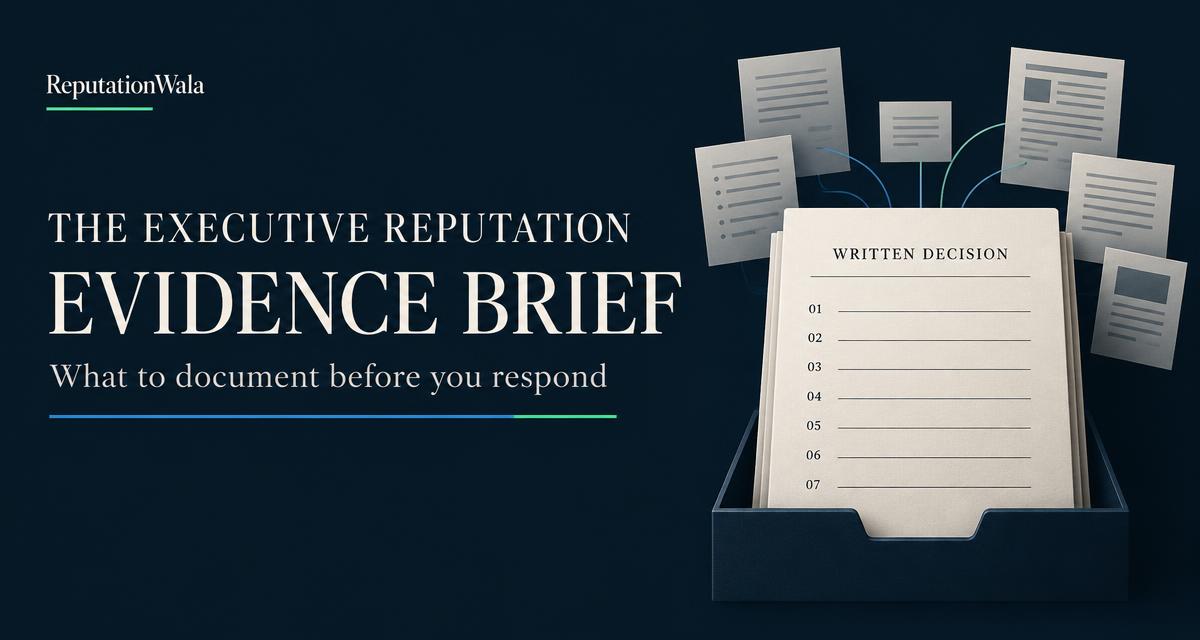
A concerning search result, article, social post or AI answer can create pressure to respond before anyone has agreed what is wrong. The first useful deliverable is not a rebuttal. It is a brief that separates the public claim, the supporting evidence and the decision someone needs to make.
This ReputationWala working framework is for founders, executives and the advisers supporting them. Its seven fields give a communications lead a reusable record to complete before contacting a publisher, reporting a post or making a public statement. It is a practical aid, not a universal standard or legal advice.
Start with a claim, not a feeling
“Our search results look bad” is not actionable. Identify the sentence, image or attribution at issue. Ask whether it is incorrect, incomplete, disputed, private or simply uncomfortable. That distinction changes both the evidence you need and the authority able to act.
Keep the publisher's page and the Google Search result separate. A publisher controls the source material; Google controls how it appears in Search. An AI answer is another surface, with its own wording and potentially several sources. A correction on one surface is not confirmation that the others have changed.
The seven-field Evidence Brief
Copy these headings into a private working document. Keep each entry concise and attach supporting records separately. “Not yet verified” is a useful answer when it is paired with an owner and a next step.
1. Exact public claim and location
Quote the specific words rather than summarising them as negative. Save the source URL and a screenshot showing context. For search or AI, record the exact query, answer and cited sources, with a timestamp and time zone. Add country, language, device and signed-in status where they may affect what appears. A capture documents one observation, not every user's experience.
Fill in: Claim, query, URL, capture time and viewing conditions:
2. Classification
Separate a checkable factual statement from a judgement. Mark disputed facts as disputed, not automatically false. Note omitted dates or qualifications that change the meaning. Impersonation and exposed private information need their own assessment. One item may contain several categories; classify the exact passage you want reviewed, not the entire publisher as hostile.
Fill in: Fact, opinion, dispute, missing context, impersonation or private data:
3. Evidence and provenance
List the records that support or challenge the claim and who supplied each. Distinguish an official filing or publisher correction from an internal recollection. Preserve dates, versions and original files privately. Identify what an independent reviewer can check, what depends on testimony and what remains uncertain. An AI answer or screenshot of a repost is evidence of appearance, not proof of the underlying claim.
Fill in: Supporting record, origin, independent confirmation and unknowns:
4. Stakeholders and actual exposure
Record actual enquiries from employees, investors, customers, partners or journalists, and the decisions they raise. Distinguish observed exposure from possible exposure. A visible post count is not proof that all those people read or believed the claim. Do not invent reach or sentiment percentages. If exposure is unknown, say so and specify the next observation that would change your assessment.
Fill in: Who encountered it, how do we know, and what decision is affected?
5. Owner and authority to act
Identify the publisher or account owner who can edit the original, the platform responsible for a policy review and the search engine responsible for its result. Note whether your team controls any affected profile. Record the appropriate contact or reporting route and who is authorised to use it. Your organisation's authority to request a correction is not authority to compel one.
Fill in: Who controls the source, the result, the profile and our response?
6. Proportionate options and limits
Compare monitoring, a private correction request, a factual profile update, a platform report and an approved public explanation. State what evidence each requires and whether it could amplify attention. A source correction does not instantly update search or AI. A Search removal does not erase the publisher's page. An explanation can supply context, but cannot require an audience to agree.
Fill in: Preferred action, alternative, expected scope and what neither can achieve:
7. Decision owner, approvals and review
Name the person accountable for the decision, not just a department. List communications, legal or other approvals required before external contact. Record the agreed action, rationale and next review date. Keep unresolved questions visible, including who will obtain missing evidence. When the source changes, preserve the before-and-after record and reassess dependent results instead of assuming the issue is closed.
Fill in: Named owner, approvers, review date and unresolved items:
One fictional worked example: an outdated founder role
Fictional example only. The people, business and observations below are invented to demonstrate the worksheet. They are not a ReputationWala client case or result.
A directory describes fictional founder Meera Shah as the current CEO of fictional Cedar Works. She has moved to a non-executive role. An AI answer repeats the directory's old description. Her adviser prepares this brief:
- 1. Claim and location
- “Meera Shah is CEO of Cedar Works.” Save the directory URL and screenshot, the exact AI query and cited directory link. Record capture time, country and device in the private case record.
- 2. Classification
- An outdated factual role attribution, with missing context about the transition. No conclusion about motive is necessary.
- 3. Evidence
- A dated company announcement and current leadership page support the change. The directory's update schedule and the AI system's source-refresh timing remain unknown.
- 4. Exposure
- A prospective partner asked which role Meera holds. Wider exposure is not established; no reach estimate is added.
- 5. Authority
- The directory editor can amend its listing. The company can maintain its leadership page. Neither controls the AI answer.
- 6. Options
- Request a factual directory correction with the announcement attached and answer the partner privately. This cannot promise immediate search or AI updates.
- 7. Decision and review
- Named decision owner: fictional communications lead Arun Rao. Meera approves the role wording. Arun assigns the next review point after contacting the directory; unresolved items are the directory response and whether dependent results change.
The decision branch: correct the right surface
First verify, then correct the source. Check that the current role is supported by reliable records. Send the directory editor the exact disputed wording, proposed factual correction and relevant evidence. Retain the response and check the live page rather than treating an acknowledgement as completion.
If the source changes but Google still shows old text, assess outdated-content refresh. Google's Refresh Outdated Content guidance covers pages or images that no longer exist, or pages where important content has been removed. For a source you do not own, check the tool's eligibility against the live page. It is not a way to remove wording that remains there. Owners should follow Google's site-owner guidance instead.
A refresh request concerns Google's result, not deletion from the web, and is subject to Google's review. It also does not refresh an AI assistant's answer. Recheck that answer separately using the recorded query and conditions; document whether it changes without assuming a guaranteed schedule.
If material is accurate but uncomfortable, do not promise deletion. Consider useful context, an accurate current profile, a private explanation or monitoring. Google's Search removal options distinguish routes involving website owners, eligible personal information and legal grounds. Discomfort alone does not establish eligibility.
When to monitor, respond or escalate
Monitor when evidence or exposure is unclear and no urgent harm is identified, with a named review point. Respond when a verifiable correction or relevant explanation can help a specific audience. Escalate when private data, impersonation, credible serious allegations or sensitive stakeholder decisions require specialist input. The Reputation Risk Escalation Matrix offers a separate framework for assessing those decisions; the Evidence Brief supplies the underlying record.
Keep sensitive evidence out of public exchanges
Share the minimum necessary information with the right recipient. Store identity documents, private correspondence and other sensitive records in an appropriately restricted private channel, not in a public reply or general enquiry form. Legal questions, including defamation, privacy and preservation duties, require qualified counsel. A communications assessment cannot decide those questions.
The finished brief should make the next decision easier, not make the issue sound larger. Keep unknowns visible and preserve a record of what changed. For implementation context, see Executive & Personal Reputation and Search & AI Reputation.
Sources and further reading
- Google Search Help: removal options and contacting the source website.
- Google Search Help: refresh outdated content and eligibility limits.
The worksheet and fictional example are ReputationWala's editorial framework. The Google references describe Google's processes, not an endorsement of this brief.