Crisis Management
The voice note reached dealers first: a private-channel crisis playbook
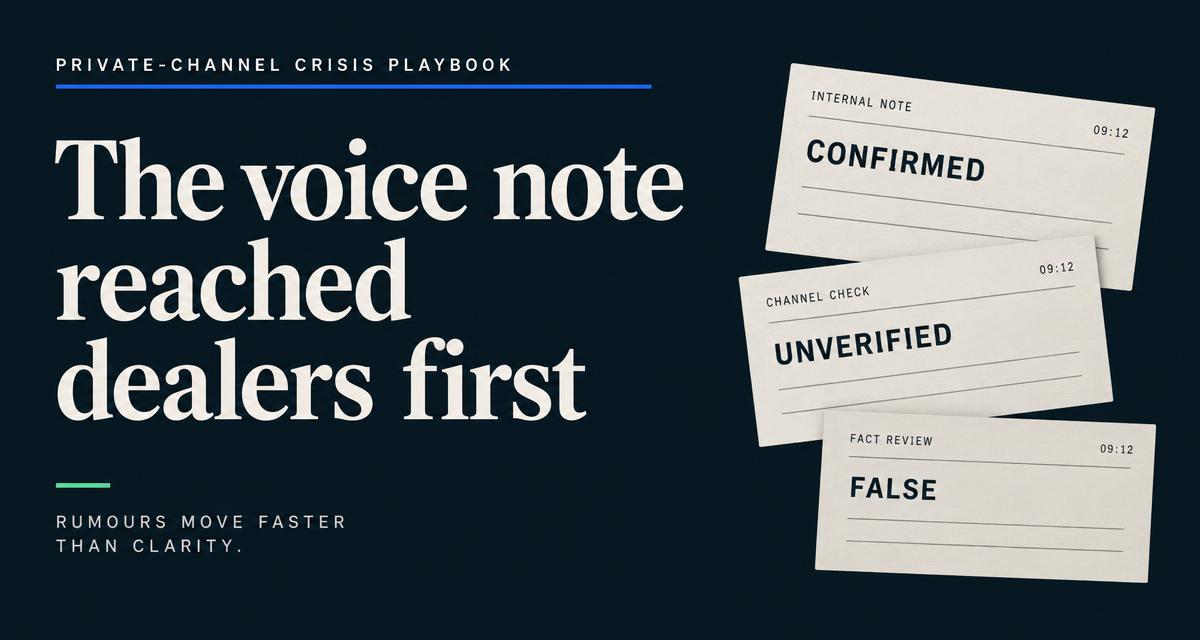
FICTIONAL composite scenario. At 9:12am, two dealers forward an audio note attributed to the managing director. It says a plant is shut and suppliers should use new bank details. Operations confirms one shift paused for a routine inspection. Finance confirms the company has not changed bank details. The voice's origin is unknown. This is ReputationWala's editorial example, not a client case.
A blanket “everything is fake” denial would be reckless. The operational detail is partially true, although a paused shift is not a plant closure. Dismissing the whole message could undermine the correction and conceal a payment risk. Split the claims before choosing the response.
The dealer is a trusted messenger, not the verified source
In a distributor network, credibility may come from the person forwarding a note. A familiar dealer can pass on an unfamiliar recording in good faith. Thank them privately; do not label them the originator. Ask what they received, when, and whether anyone has changed an order, delivery commitment or payment because of it.
The first audience is the people making those decisions: dealer principals, distributor accounts teams and supplier finance contacts. Reach them through known relationship managers and existing authenticated channels. A broad social post may miss them while introducing the rumour to people who never encountered it.
Run two clocks, with one decision record
The fact clock verifies operations and payment instructions. The exposure clock maps the message's observed path and the decisions it is affecting. Run them in parallel. Do not wait for a complete forwarding history before warning a partner about disputed bank details; do not convert two reports into an invented estimate of network-wide reach.
Communications keeps a restricted record. Each entry needs a named person, evidence location, status, decision and next check. This compact version starts the fictional incident:
- 1. Operations, confirmed: One shift paused for routine inspection. Operations lead records affected work and delivery implications. The plant-closure claim is false as stated; confirm scope before publishing a correction.
- 2. Finance, false: The claimed company bank-detail change is not authorised. Finance lead confirms current instructions through existing authenticated channels and checks for attempted transfers.
- 3. Security, unverified: Speaker identity, recording origin and alteration remain unknown. Security lead preserves the received file and context; no “AI-generated” label is approved.
- 4. Channel sales, observed: Two dealers reported receipt. Channel sales lead logs known recipients and actual decisions affected. Communications lead owns the approved update and next review point.
A practical first-hour sequence
These are working checkpoints, not a promise that every investigation finishes within an hour. Assign named individuals to the roles immediately, including a deputy for unavailable approvers.
Opening minutes: preserve and protect. Channel sales retains the original received message, sender context and timestamps, including time zone. Security stores the file without editing it, with restricted access and a record of who supplied it. Keep listening copies separate. Ask reporting partners not to circulate the suspicious audio further.
Finance independently calls affected accounts contacts using numbers already held in verified records, not numbers supplied in the note. Confirm payment instructions through the existing authenticated process. Request a pause on any proposed change prompted by the recording, following contractual and internal controls; do not order a blanket freeze of unrelated payments.
Next: verify the claims independently. Operations checks the shift record, inspection status and actual dispatch implications with the plant lead. Finance checks whether any authorised change exists. Communications records the answers separately. A detector score or “sounds like him” is not proof. Security may seek specialist examination, but file analysis cannot replace operational verification.
Before the first partner update: identify decisions at risk. Channel sales asks known recipients whether shipments, customer commitments or payments have changed. Record first-hand reports separately from “someone said the whole group has it”. Ask only for relevant forwarding context, not an export of private group conversations or unrelated personal data.
Within the first hour where feasible: approve and deliver. Operations approves the operational sentence; finance approves payment instructions; communications assembles the message. Security or legal reviews fraud allegations and preservation needs where appropriate. Channel sales sends the approved text through established partner channels, then checks receipt with the decision-makers. Log unanswered contacts and the next update owner.
A partner holding message with usable instructions
The following is a fictional template. Replace brackets only with verified facts and approved contacts. It does not require forwarding the audio or publishing its bank details.
We are checking an audio message attributed to our managing director. We have confirmed [one shift paused for a routine inspection; verified operational and delivery position]. This does not mean [verified correction to the plant-closure claim].
[Finance has confirmed that company bank details have not changed.] Do not act on payment changes in that message. Verify instructions through [existing authenticated partner channel] and call [your finance contact using the number already in your records], not a contact supplied in the recording.
We have not established who made the recording or whether it was altered. Please report any affected payment or delivery decision privately to [approved contact]. Our next update will be at [owner-approved time and time zone], even if checks remain open. Please do not circulate the recording further.
If operations cannot yet confirm delivery impact, say that explicitly. Keep versions consistent across regional teams and languages. A relationship manager should not improvise a more reassuring answer than the approved facts support.
Public response and specialist escalation are separate decisions
Consider a public statement when there is observed wider spread, customer impact or public enquiries that a partner-only update cannot address. Publish verified facts and a safe verification route, not the recording or disputed banking information. Limited public visibility is not a reason to delay private payment-risk action.
Suspected payment diversion, attempted transfers or compromised accounts warrant immediate finance and security escalation. Use established bank fraud contacts where relevant. Seek law enforcement or qualified counsel as appropriate to the evidence and jurisdiction; preserve records and avoid naming a suspected perpetrator without substantiation.
The Reputation Risk Escalation Matrix helps decide when leadership involvement is warranted. This playbook is narrower: it coordinates operational facts, partner decisions and payment safeguards before the public narrative is clear. For support context, see Crisis & Issues Management and Social Listening & Response Management.
Close the loop on understanding, not just distribution
Check whether affected partners understand the shift position and know how to verify payments. Record attempted or completed payment changes, corrective actions, revised order instructions and which observed recipients received the correction. A sent message is not proof of understanding; follow up on unanswered questions and mistaken interpretations.
Keep unresolved provenance and operational questions assigned to named owners. Review failed contact paths, approval delays and inconsistencies between teams. The useful outcome is a better-supported next decision, not a claim that the rumour has disappeared.
Sources and scope
- NIST: Reducing Risks Posed by Synthetic Content. The publication examines authentication, provenance tracking and synthetic-content detection as distinct technical approaches. A familiar-sounding voice or detector score alone does not establish the recording's origin or the truth of its claims.
- FTC: voice impersonation in family-emergency scams. Its independent callback principle is adapted here; this is US consumer guidance, not India-specific business advice.
- CDC: Crisis and Emergency Risk Communication manual. Its communication framework informs clear, audience-specific updates, not audio authentication.
The fictional scenario and working sequence are ReputationWala's editorial example, not a universal incident standard or legal advice. Technical findings require appropriate expertise; legal questions require qualified counsel.